Does Dog Poop Attract Coyotes? The Honest Answer
· Poo Squad
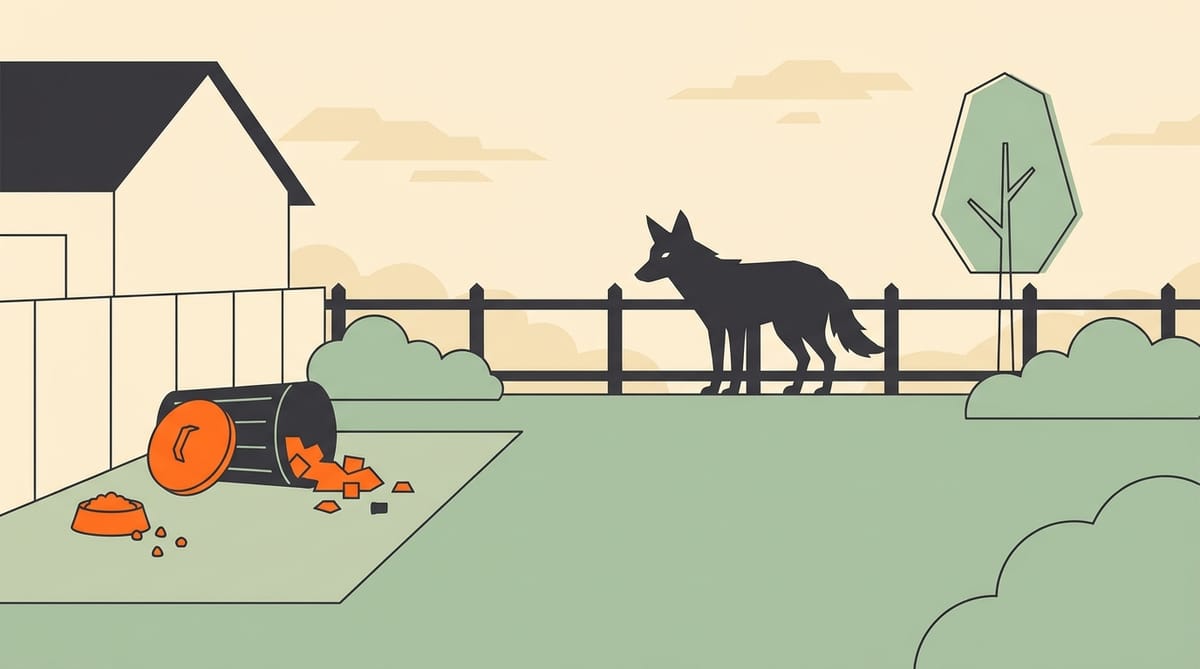
You spot tracks across the lawn one morning. Or maybe just a tipped trash can. Maybe the neighbor swears she saw something at the fence line.
And the first thing you wonder is — is it the poop?
Kind of. But not in the way you'd think. We scoop yards full-time, and the coyote-and-dog-poop connection comes up a lot. Here's the honest version — what actually pulls a coyote into a backyard, where waste fits in, and how to make your yard less interesting to one.
The Short Answer
Dog poop doesn't attract coyotes the way it attracts flies or rats. But it tells a coyote a dog lives here — and that's information they use.
Coyotes are scent-driven. A yard with uncollected piles smells like "dog territory" to a passing coyote. That's not a dinner bell. But it's a flag. Combine that flag with food, garbage, a water source, or a small unattended dog, and you've made a yard worth checking out.
Clean the yard, lock the trash, kill the easy attractants, and the coyote loses interest fast. That's the whole answer. The rest is the why.
Coyotes Aren't Hunting Poop. They're Hunting Easy Calories.
This is the piece a lot of homeowners miss.
A fly is drawn to fresh waste. A rat treats old waste as food. A coyote does neither. Coyotes are omnivores chasing the highest-calorie meal for the least effort. Their diet skews toward small mammals, birds, rabbits, fallen fruit, garbage, pet food left outside, and — yes — small unattended pets when the opportunity shows up.
Dog scat isn't on that menu. Wildlife biologists who track urban coyotes through scat analysis have not found dog feces showing up as a regular food source. It just isn't worth their effort.
So the poop itself isn't the prize. The yard around it is.
Where Dog Poop Actually Fits In
Here's where it gets useful for a coyote — as a scent signal.
A yard with multiple piles smells like dogs. Coyotes are territorial. They read scent the way we read a street sign. Multiple piles means a resident dog. A resident dog means there's a routine — feedings, walks, time outside, time alone.
That doesn't make a coyote attack inevitable. Most coyotes want nothing to do with humans. But if a coyote is already in the area looking for opportunity, a yard that broadcasts "dog lives here, food might be near" is more interesting than a yard that doesn't.
It's the same logic as leaving porch lights off and the trash open. None of those things "summon" a coyote. They just remove the friction.
The Urine vs. Scat Thing People Get Wrong
You'll see articles online claiming dog poop scares coyotes off — that they treat it as another predator's territory marker.
Mostly false. Coyotes use urine, not feces, for territorial marking. Their own scat usually shows up in prominent spots like trail centers or driveway edges — but that's more about visibility than chemistry. A pile of dog poop in your grass doesn't say "stay away" to a coyote. It just says "a dog uses this yard."
So if anyone's told you to leave the piles in the lawn as a coyote deterrent — that's a backyard myth. It's making the yard smell more like prey territory, not less. And it's piling up health problems for your own dog at the same time.
Coyote Scat in Your Yard Is a Different Conversation
Now flip it. If you're finding coyote droppings in the lawn, that's the real warning sign.
Coyote scat looks different from dog scat. It's typically rope-shaped, tapered at the ends, and full of hair, bone fragments, fruit seeds, or feathers. If you find piles that match that description, you're being told a coyote walked through — possibly more than once. (If you're not sure what you're looking at, our backyard animal poop identification guide has photos and details for every common backyard species.)
That matters for two reasons. First, it confirms a coyote has been in the yard, usually at night. Second, coyote scat can carry parasites — including roundworms and tapeworms — that your dog can pick up by sniffing or eating it. Removing it fast, gloves on, double-bagged, is the right move.
If you keep finding coyote piles week after week, that yard is on someone's route. Worth a call to local animal control or your state wildlife office.
What Really Pulls a Coyote In
If you want to take coyote risk seriously, dog waste is one item on a longer list. The big attractants in any suburban yard:
- Pet food left outside — the single biggest mistake. A bowl on the porch is a billboard.
- Unsecured trash — coyotes will tip cans, drag bags, and learn your trash night.
- Fallen fruit — apples, pears, plums under a backyard tree. Easy calories.
- Bird feeders that spill — they feed rodents on the ground, which feed coyotes.
- Compost piles with meat scraps — vegetable-only is fine, mixed is not.
- Standing water sources — same wet yards that wet, neglected piles also feed mosquitoes draw thirsty wildlife.
- Small pets out alone — cats, small dogs, rabbits in unsecured runs.
- Dog poop pileup — the scent signal we just talked about.
Picking up after your dog every couple days knocks out the last item. The other items are the ones doing the heavy lifting in terms of "yard worth visiting."
How to Make Your Yard Less Interesting
The strategy is boring on purpose. You don't have to scare a coyote off — you just have to bore them off.
Here's the working list. None of it requires you to confront a wild animal.
- Scoop the yard regularly. A few times a week minimum. We recommend you scoop the yard at least twice a week for dogs of any size, more if it's a multi-dog household.
- Feed pets indoors. Always. If you must feed outside, pick up the bowl within 30 minutes.
- Secure the trash. Animal-proof cans, lids latched, stored in the garage when possible.
- Motion lights. Especially aimed at fence lines and yard corners. Coyotes are nocturnal and avoid sudden bright light.
- Keep sight lines open. Trim shrubs and tall grass at the yard's edge. Coyotes prefer cover.
- Don't leave small dogs out alone. Especially at dawn and dusk. Especially in fall and winter, when coyote pups are training.
- Reinforce the fence. Six feet tall is the standard, with the bottom dug or buried to keep coyotes from digging under.
None of these are dramatic on their own. Stacked together, they make a yard not worth a coyote's time.
What Scooping Actually Fixes
Let's be honest about what cleaning the yard does and doesn't do here.
It does:
- Remove the "dog lives here" scent signal that flags your yard to a passing coyote
- Cut down on flies, gnats, mosquitoes, and the rodent problem that follows (and rats love an uncollected pile — which in turn pulls in more coyotes)
- Eliminate parasite reservoirs that put your own dog at risk
- Make it easier to actually see whether a coyote has been through (you can spot the scat instead of stepping in it)
It doesn't:
- Repel coyotes that already have a hunting route through your neighborhood
- Replace fencing or motion lighting
- Substitute for keeping small dogs supervised
So scooping is one layer in the strategy. Not the whole thing. But the first one — and the cheapest.
If You've Already Seen a Coyote in the Yard
Different conversation. Now the question isn't "am I attracting them" — it's "how do I make this not happen again."
A few rules:
Never feed a coyote. Never run from one. Make yourself big, loud, and unpleasant — wave arms, shout, throw something in their direction (not at them). This is called hazing, and it's the standard recommendation from wildlife agencies including Mass.gov's coyote FAQ. The goal is to keep coyotes afraid of humans, which is what keeps people and pets safe.
If a coyote is being aggressive, lingering after hazing, or following a dog, call animal control. That's a coyote that has lost its caution, and that's a public-safety issue, not a yard issue.
For ongoing dog safety on walks, leashes, daylight hours, and never leaving small dogs unattended in unfenced yards are the basics. AKC's guide to protecting your dog from coyotes has the full picture if you want to go deeper.
What If the Yard Has Gotten Away From You?
Real talk. Sometimes life gets ahead of the scoop schedule.
If you're looking at a yard with weeks of buildup, two big dogs, and a coyote you keep spotting at the fence — start with a one-time deep cleanout. Then move to a weekly schedule.
That's what we do. Our crews handle weekly residential scooping in 23+ cities so you don't have to think about it. You can find Poo Squad in your city on our location map.
It's not glamorous work. We know dog poop. Unfortunately. But it's the cheapest single thing you can do to make a yard less interesting to wildlife — coyotes included.
FAQ
Does dog poop scare coyotes away?
No. Coyotes use urine, not feces, to mark territory. Dog poop in the yard doesn't function as a deterrent — if anything, it signals to a passing coyote that a dog lives there.
Will coyotes eat dog poop?
Not typically. Wildlife biologists studying urban coyote diets through scat analysis don't find dog feces as a regular food source. Coyotes target higher-calorie food — rodents, fallen fruit, garbage, and pet food. Dog waste isn't worth the trip.
How can I tell if a coyote has been in my yard?
Look for scat that's rope-shaped, tapered, and full of hair, bones, fruit seeds, or feathers. Tracks are oval, with four toes and claw marks, and tighter than most dog tracks. Most coyote activity happens between dusk and dawn, so check the lawn at first light.
How often should I scoop the yard to keep coyotes from being interested?
Twice a week is the minimum for any dog household. For multi-dog households or yards where you've already seen coyotes, three times a week is better. The goal is to keep the "dog lives here" scent signal as faint as possible.
Is dog poop really a real attractant compared to other things?
Not on its own, no. The bigger attractants are pet food left outside, unsecured trash, fallen fruit, and small unsupervised pets. Dog waste is a contributing scent signal, not the main draw. But it's the easiest one to fix — and it's also feeding flies, rats, and parasites your dog can pick up. So it's worth handling regardless.
The Bottom Line
Coyotes aren't coming for the poop. They're coming for the easy meal, and the poop is one of several signals telling them your yard has a dog and a routine to read.
Clean the yard, lock the trash, keep the food inside, and most coyotes will move on to a less complicated lawn.
If the yard has gotten ahead of you, that's what we're here for. Find Poo Squad in your city and we'll take the mess off your hands so you can focus on the parts of coyote-proofing that actually need you.