How Long Can a Dog Hold Their Poop? | Poo Squad
· Poo Squad
You're stuck in traffic. Your dog's home alone. And you're doing the math on how long it's been since they last went out.
We get it. So here's the short answer first.
A healthy adult dog can usually hold their poop for 8 to 12 hours. Overnight is fine for most. Past 12 hours, you're pushing it. That's when discomfort and constipation start creeping in.
But "usually" is doing a lot of work in that sentence. Age, health, diet, and routine all change the number. Let's break it down.
The Quick Answer, by Age
Not all dogs are built the same. A puppy and a senior dog live on totally different clocks.
Puppies: Barely any control. A rough rule is one hour per month of age, capped around the limits below. An 8-week-old pup might need to go every 1 to 2 hours. They're not being difficult. Their plumbing just isn't finished yet.
Adult dogs: The 8-to-12-hour crowd. Most can comfortably make it through a workday or a night's sleep. Doesn't mean they should do it every single day.
Senior dogs: The number shrinks again. Weaker muscles, slower digestion, sometimes incontinence. Older dogs often need more frequent trips out, not fewer.
Why You Shouldn't Push the Limit
Just because a dog can hold it doesn't mean it's good for them.
Here's what happens inside. The longer poop sits in the colon, the more water gets pulled out of it. The stool turns dry, hard, and painful to pass.
Do that regularly and you're inviting trouble. Think constipation in dogs, anal gland issues, even a stretched-out bowel over time.
So the goal isn't "what's the max." It's "how do I make sure they rarely have to wait that long."
How Often Should a Dog Poop Anyway?
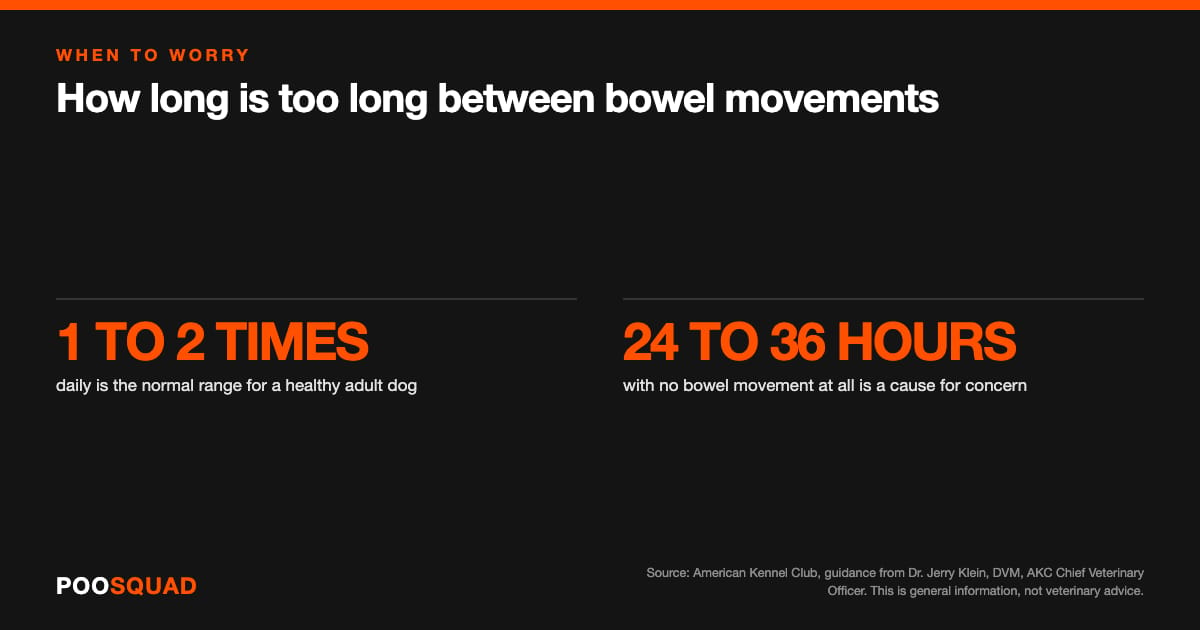
Most healthy adult dogs go once or twice a day. Some go three times. All of that can be normal.
What matters more than the exact count is the pattern. A dog that reliably goes twice a day and suddenly hasn't gone in 24 hours is telling you something.
If you want the deeper dive, the vets at PetMD have a solid rundown on how often dogs should poop. The short version: know your dog's normal, and watch for changes.
What Makes a Dog Need to Go Sooner
A few things shorten the clock. Worth knowing so you're not caught off guard.
Meals. Eating triggers the urge to go. Many dogs poop within 30 minutes of a meal. Feed right before you leave for 9 hours? Plan accordingly.
Diet changes. New food, table scraps, a different treat. Their gut reacts fast. Sometimes with watery, loose stool that won't wait.
Exercise. Movement gets things moving. A walk often ends with a poop. That's not a coincidence.
Stress. A thunderstorm, a new house, you leaving. Anxiety can speed up the whole system.
Does Size or Breed Change the Number?
A little, but not as much as people think.
Small dogs have smaller bladders and sometimes faster metabolisms, so toy breeds may need to go a touch more often. Big dogs aren't automatically built to hold it longer, either. Size is a minor factor.
Age and health matter far more than breed. A healthy 4-year-old Chihuahua and a healthy 4-year-old Lab land in roughly the same 8-to-12-hour window. Don't let breed myths talk you into leaving any dog longer than they're comfortable.
What About Crate-Trained Dogs?
Crate training works because dogs don't like to soil where they sleep. They'll hold it longer in a crate than loose in the house.
But that instinct can backfire. A dog who holds it past their limit because they're stuck in a crate isn't "well trained." They're stressed and uncomfortable.
Use the same time limits either way. The crate isn't a reason to stretch the clock. It's just a tool to help with house training.
Holding It Overnight vs. During the Day
People always ask about overnight. Good news there.
Dogs slow way down when they sleep. Their digestion idles. That's why a dog who poops twice during the day can comfortably go all night without a single trip outside.
Daytime is different. They're awake, moving, drinking water, sometimes eating. The same 10 hours feels a lot longer to a dog who's up and active.
So an 8-hour workday can actually be harder on them than an 8-hour night's sleep. Keep that in mind before you assume "they're fine, they sleep that long anyway."
What Happens When They Just Can't Hold It
Sometimes the answer is simple. They go in the house. And honestly? That's often on us, not them.
A dog left too long isn't being bad. They held it as long as their body allowed, then nature won. Punishing that doesn't teach anything except fear.
The fix is almost always about schedule, not discipline. More trips out. A midday break. A dog walker. A doggy door if your setup allows.
Building a Schedule That Works
Here's a simple frame that keeps most dogs comfortable.
Out first thing in the morning. Out after meals when you can. Out before you leave for the day. And out again the moment you're back.
Working long hours? A midday potty break changes everything. Even one. It cuts that 10-hour stretch in half and saves your dog a lot of discomfort.
Got a puppy or a senior? Tighten that schedule up. They need it.
Learn your dog's tells, too. Pacing, sniffing in circles, whining at the door, sudden restlessness. That's not random. That's them asking. The faster you answer, the less likely they are to ever reach their limit.
When to Actually Worry
Holding it on purpose is one thing. Can't go is another.
Call your vet if your dog:
- Hasn't pooped in 48 to 72 hours
- Is straining, crying, or crouching with nothing coming out
- Passes hard, dry, pebble-like stool
- Seems bloated, sluggish, or off their food
- Has blood or mucus in their stool
These aren't "wait and see" signs. They point to constipation, blockage, or something that needs a real exam. Trust your gut. You know your dog.
Where Poo Squad Fits In
Okay, so your dog's on a good schedule and going regularly. Great. Now somebody has to deal with what lands in the yard.
That's the part nobody signs up for. And the more reliably your dog goes, the faster a backyard fills up.
Left alone, those piles break down and stick around in your yard longer than you'd think — feeding flies, killing grass, and waiting for someone's shoe.
That's where we come in. Our residential pooper scooper service shows up weekly, walks your whole yard, scoops every pile, bags it, and hauls it off. You keep the walks and the belly rubs. We take the gross part.
The Bottom Line
A healthy adult dog can hold their poop 8 to 12 hours. Puppies and seniors, a lot less. They can stretch it, but they shouldn't have to often.
Give them regular chances to go. Watch for changes. And let us handle the cleanup.
Frequently Asked Questions
How long can a dog hold their poop overnight?
Most healthy adult dogs can hold their poop for 8 to 10 hours overnight without trouble. Digestion slows during sleep, so a full night is comfortable for the average adult dog. Puppies and senior dogs usually can't make it that long and may need a late-night or early-morning trip out.
How long can a puppy hold their poop?
Not long. A common guideline is about one hour per month of age. So a two-month-old puppy may only hold it for two hours or so. Young puppies have very little bowel control and need frequent trips outside, including overnight at first.
Is it bad for a dog to hold their poop too long?
Yes, if it happens regularly. The longer stool sits in the colon, the more water is absorbed, making it dry and hard to pass. Over time that can lead to constipation, anal gland problems, and discomfort. Occasional long stretches are usually fine; daily ones are not ideal.
How long can a dog go without pooping before I should worry?
If a dog hasn't pooped in 48 to 72 hours, or is straining without producing anything, call your vet. Combined with bloating, loss of appetite, or visible discomfort, a lack of bowel movements can signal constipation or a blockage that needs attention.
Will my dog poop in the house if I leave them too long?
They might, and it's usually not bad behavior. A dog left beyond what their body can hold will eventually have to go. The fix is a better schedule — more frequent trips out, a midday break, or a dog walker — not punishment.
Keep the Yard, Skip the Cleanup
You take care of the schedule, the walks, the trips out. We'll take care of what ends up in the grass. Find your local Poo Squad and get your yard back — minefield-free.