How Long Does Dog Poop Take to Decompose? | Poo Squad
· Poo Squad
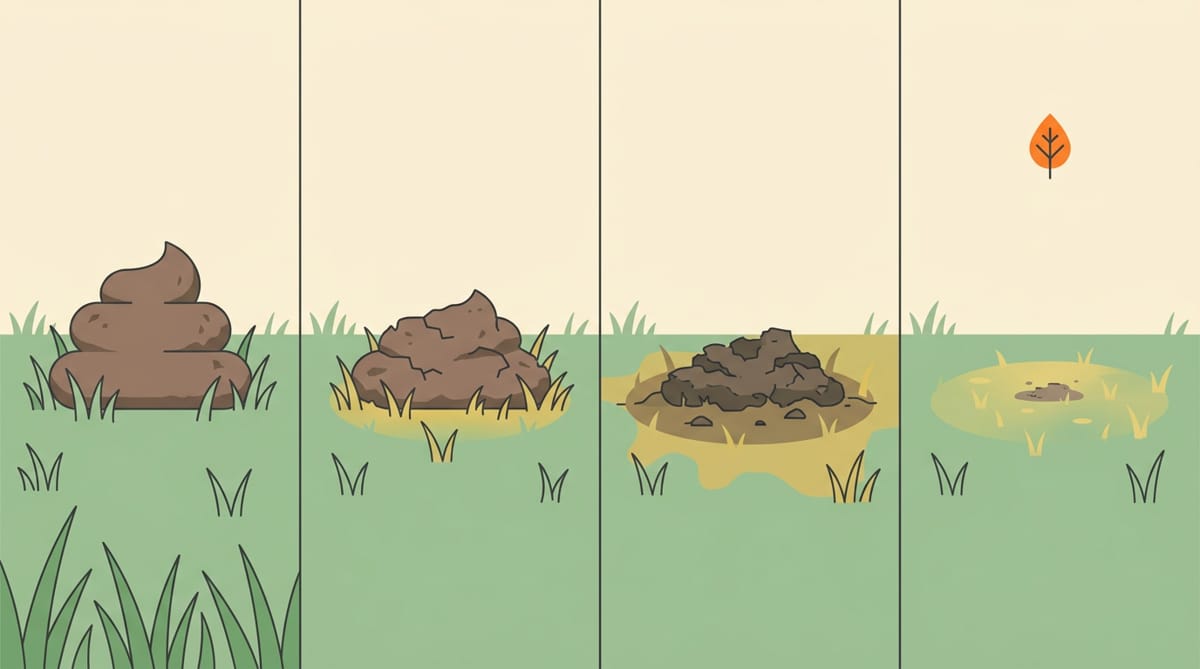
You scooped last weekend. Maybe.
Now it's Saturday again, the yard smells weird, and there are mystery piles you don't remember leaving. So the obvious question pops up: how long does dog poop actually take to decompose? Can you just leave it and let nature take over?
Short answer: nature is slow. And kind of grossed out by your dog's diet.
Here's the real timeline, the stuff that speeds it up, the stuff that slows it down, and why "let it break down on its own" is the worst lawn-care strategy you can pick.
The Honest Answer: 9 Weeks to a Full Year
In a perfect world — warm temperatures, regular rain, healthy soil microbes — a single dog poop takes about 9 weeks to fully break down.
That's already longer than most people guess.
In the real world? It's usually 6 to 12 months. Sometimes longer. A frozen winter pile can sit in your yard, basically unchanged, until spring.
That's not decomposition. That's storage.
Why It Takes So Long
Dog poop isn't like cow or horse manure. Cows and horses eat grass. Their waste breaks down into compost-friendly stuff pretty quickly.
Dogs eat meat-based food packed with protein, fat, and additives. That makes their waste more acidic, more nitrogen-heavy, and a lot harder on the bacteria that would normally do the breakdown work.
It also makes dog waste a poor fertilizer, no matter what your neighbor thinks of itself as garden gold. (Spoiler: it kills grass more often than it feeds it.)
What Speeds Decomposition Up
A few things help dog poop break down faster:
- Heat. Microbes wake up around 60°F and party at 80°F+. Summer poop breaks down faster than spring poop.
- Moisture. Damp soil = active bacteria. A wet spring helps. A drought stalls everything.
- Direct contact with soil. Poop on bare dirt breaks down faster than poop sitting on top of thick grass.
- Healthy soil microbes. If your lawn has good biology, it has more workers on the job.
Even with all those boxes checked, you're still looking at weeks, not days.
What Slows It Way Down
And these are the things working against you most of the year:
- Cold. Below 50°F, microbial activity tanks. Below freezing, it basically stops.
- Drought. Dry waste turns into a hard, mummified pile. Microbes can't work without water.
- Thick turf. Dense grass keeps poop off the soil and away from the bacteria that would eat it.
- Sheer volume. One dog producing every day means new poop lands faster than old poop disappears.
That last one is the killer. Most yards aren't decomposing one pile. They're decomposing dozens.
The Math Most People Don't Do
A medium-sized dog drops about three-quarters of a pound of poop a day. That's roughly 274 pounds per year.
Two dogs? Over half a ton.
If decomposition takes 9 weeks at best, and your dog poops daily, there's always old waste in your yard. Always. Even if you scoop once a week, the older stuff is still working its way through the breakdown process underneath the new stuff.
That's not a lawn. That's a slow-release problem.
Why "Just Let It Decompose" Backfires
Here's the part the "nature handles it" crowd skips: as dog poop breaks down, it doesn't disappear into nothing. It leaches into your soil and your water.
The EPA labeled it a non-point source pollutant back in 1991, right next to oil runoff and pesticides. One gram of dog poop contains roughly 23 million fecal coliform bacteria. That's not a typo.
And the parasites are stubborn. The CDC notes that hookworm and roundworm eggs can stay alive in soil for years after the visible poop is long gone. Kids playing barefoot, dogs sniffing around, you gardening — all real exposure paths.
"Letting it decompose" doesn't deactivate that stuff. It just hides it.
What About Dog Poop Bags?
Different timeline, same problem.
A regular plastic poop bag can sit in a landfill for 500+ years before it breaks down. "Biodegradable" bags are better, but most of them need oxygen and sunlight — neither of which is plentiful in a buried landfill — to actually break down in any reasonable time frame.
Compostable bags work only in industrial composting facilities. Tossing one in your backyard compost won't do much.
The bag isn't the magic. Pickup is the magic. The bag just gets it where it needs to go.
What About Burying It?
People ask this a lot, and the answer is: please don't.
Buried poop doesn't decompose meaningfully faster than poop on the surface. It still contaminates groundwater. It still leaves parasite eggs in the soil. And if you bury near a vegetable garden, you've just contaminated your tomatoes.
Don't bury it near storm drains, creeks, or vegetable beds. Honestly, don't bury it at all.
What Actually Works
If your goal is a clean, safe, usable yard — not a science experiment — you've got a few options:
- Scoop regularly. Weekly is the minimum. Twice a week if you have multiple dogs.
- Use a dedicated waste bin. Bag it, lid it, get it to the curb.
- Hire it out. Most professional services scoop weekly or bi-weekly for less than people expect.
If you want to learn more about residue, smells, and lingering stains after a pile is gone, here's what actually dissolves dog poop in your yard. (Hint: it's not vinegar. It's not lime. It's scooping.)
Where Poo Squad Comes In
We started Poo Squad because nobody wants to spend Saturday morning hunched over their lawn with a plastic bag.
Our crews handle weekly residential scooping in over 23 cities. We show up, we clear the yard, we bag and haul it away. You get the yard back.
No decomposition math. No mummified piles under the deck. No mystery smells in July.
FAQ
How long does dog poop take to decompose in summer?
In warm, moist summer conditions, dog poop can break down in about 8 to 9 weeks. That's the fastest realistic timeline. Heavy turf, drought, or a thick mat of grass clippings will stretch it longer.
Does dog poop ever fully disappear on its own?
Visually, yes — eventually. But bacteria like E. coli and parasite eggs like roundworms and hookworms can stay in the soil for months or years after the pile itself is gone.
Is dog poop good for the lawn as fertilizer?
No. It's too acidic and nitrogen-heavy. It burns grass and leaves yellow patches. It's not the same thing as cow or horse manure, which comes from plant-eating animals.
How often should I scoop my yard?
At least once a week. Twice a week if you have multiple dogs, kids who play in the yard, or any storm drains nearby. Daily pickup is the gold standard.
Can I compost dog poop?
Not in a normal backyard compost bin. The temperatures don't get high enough to kill the parasites. Some cities have separate pet waste composting programs — check yours before assuming.
The Bottom Line
Dog poop takes way longer to decompose than people assume. And while it's slowly breaking down, it's also slowly polluting your soil, your water, and (if you're unlucky) your kids' bare feet.
Scooping isn't optional. It's just the question of who's doing it.
If you'd rather it not be you, find your local Poo Squad crew. We handle the mess. You get the yard back.