How Often Should You Pick Up Dog Poop? (Real Answer)
· Poo Squad
This is the question we hear most. Right after "wait, you really do this for a living?"
So let's just answer it.
How often should you actually be picking up dog poop in your yard? Short answer — more often than most people are. Daily is best. Weekly is the floor. Past a week, problems start. Pile-up problems. Smell problems. Lawn problems. Sometimes worm problems.
The longer answer — the one that actually changes how you treat your yard — depends on how many dogs you have, how big the yard is, what the weather's been doing, and whether kids or a vegetable garden are anywhere in the picture. Let's walk through it.
The Honest Answer, in One Sentence
Pick up dog poop daily if you can, every 2–3 days at the absolute latest, and never let it sit longer than a week.
That's the rule pretty much every vet, every lawn care pro, and every pet waste removal company will give you. It's also what we live by. We scoop yards for a living, and we still tell our own customers that between visits, a quick walk-around with a bag is worth doing.
Why so often? Because dog poop changes fast. Faster than people think.
What Actually Happens When You Wait
Here's the timeline. Not to be preachy. Just because most people don't realize how quickly things go sideways.
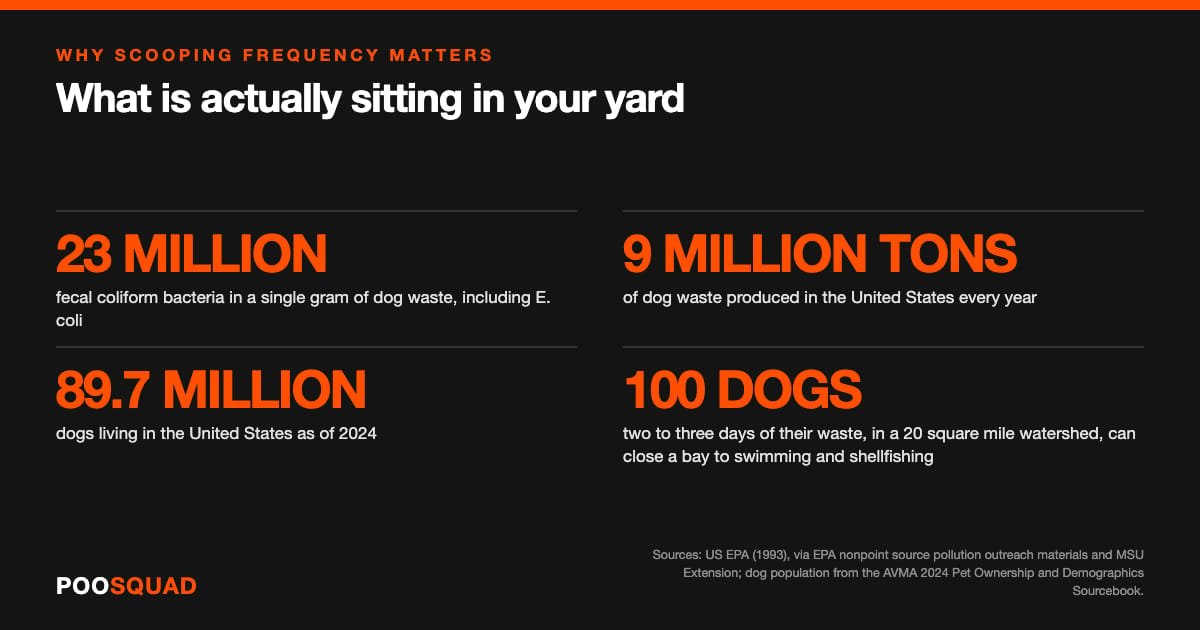
Within 24 hours: Bacteria starts multiplying. One gram of fresh dog poop can carry up to 23 million fecal coliform bacteria — including E. coli and salmonella. After a day on warm grass, that count climbs.
48 to 72 hours: The smell shifts. It's not just stronger — it's different. Ammonia, sulfur, methane. Flies start finding it within minutes in summer. In hot weather, eggs become maggots in 12 to 24 hours. We've seen yards go from "fine" to "infested" between a Friday and a Monday.
One week in: Lawn burn starts. Yellow patches around each pile. Sometimes dead spots that take a full season to grow back. The acidic, nitrogen-heavy mix in dog waste is the opposite of good fertilizer for grass — more on that in a minute.
Two weeks: Parasites can settle into your soil. According to the CDC, roundworm eggs can survive in soil for years. That's not us being dramatic. That's the agency that tracks zoonotic disease.
One month: Now it's a hazard zone. Kids shouldn't be playing in it. Bare feet shouldn't be in it. The dog probably won't even use that part of the yard anymore. (Dogs are pickier about where they poop than people give them credit for.)
None of this is meant to scare anyone. But "I'll get to it next weekend" turns into a real problem fast.
How Often Based on Your Situation
The right frequency isn't one-size-fits-all. Here's a quick read.
One dog, large yard: Every 2–3 days is the floor. Daily is better. The poop spreads out, sure, but it's also harder to find when you finally do hunt for it. We always suggest a quick lap with a bag every other day.
One dog, small yard: Every other day at minimum. Small yards concentrate everything — smell, bacteria, lawn damage. Daily is the move.
Two dogs, any yard: Daily. Two dogs roughly doubles output. Smell, fly attraction, and lawn burn climb fast. Weekly cleanup just won't keep up.
Three or more dogs: Daily — and sometimes twice. We have customers in multi-dog households who need us out two or three times a week just to stay on top of it. Daily walk-arounds in between are normal.
Kids playing in the yard: Daily, no exceptions. Kids put hands in mouths. Hands touch grass. Grass touches whatever was on it three days ago. Not worth the risk.
Vegetable garden nearby: Daily. Pet waste runoff into edible plants is a hard no — and the EPA flags pet waste as a real source of soil and water contamination near gardens.
Pregnant family member or someone immune-compromised: Daily. Some of the parasites in dog waste cause real complications for people with weakened immune systems.
Weather Changes Everything
People always ask if frequency should shift with the seasons. Yes — and more than you'd think.
Hot weather: Smell explodes. Flies multiply. Bag weight gets… let's call it unpleasant. We always recommend picking up before the heat of the day, not after work. A pile that's sat in 90-degree sun all afternoon is a different beast than the morning version.
Rain: Rain spreads dog poop. Hard. Bacteria leaches into soil. Runoff carries it into storm drains. The EPA classifies pet waste as a nonpoint source pollutant for exactly this reason. Pick up before a storm if you can. After is harder, smellier, and less effective.
Snow: The big one. People stop scooping in winter, then face a "spring thaw weekend" they did not plan for. We've answered hundreds of calls in March and April that all started with "we didn't pick up all winter." If you skip winter, plan for a one-time spring catch-up — or just keep up with it, even when it's cold.
Wind: Doesn't change frequency, but it does change how you bag. Tie tighter. Use a heavier bag. Or use a poop scooper with a lid.
Why People Fall Behind (We Get It)
This isn't a guilt trip. It's just real.
Most of our customers fell behind for one of these reasons. Maybe more than one.
- It's gross. Some days, you just don't want to.
- The yard's big. By the time you find pile #4, you've forgotten where pile #1 was.
- You're tired after work, kids, dinner, dishes.
- You forgot. Three times in a row. Now it's an avoidance thing.
- The dog poops in spots you can't reach without a flashlight, the long-handled scoop, and a real plan.
- You have allergies, a bad back, mobility issues, or you're pregnant.
- You travel. The dog stays. The poop accumulates.
This is exactly why we started Poo Squad in 2017. Not because anyone wants a stranger in their yard once a week. Because life happens, and the yard still has to function.
When to Hire It Out
Some honest signs it's time:
- You're already 2+ weeks behind and the thought of catching up is exhausting.
- You have more than 2 dogs.
- You have allergies, asthma, or a back that doesn't love bending over.
- You're done bagging in the rain. Or the snow. Or before-work-on-a-Tuesday.
- The yard's big enough that "a quick walk-around" takes 25 minutes.
- You'd rather spend Saturday doing literally anything else.
None of these are weakness. They're math. If a weekly pooper scooper service costs less than what you'd pay yourself for an hour of weekend time, the math works.
How Professional Services Are Set Up
Most pet waste removal companies — including us — work in three rough buckets.
Weekly: The most popular by a wide margin. Same day each week. Most one-dog and two-dog households use this. Yard stays consistently clean. Smell stays manageable. Flies don't get a foothold in summer.
Bi-weekly: Every other week. Works for some one-dog households, especially with bigger yards. Honest tradeoff: it's cheaper, but the yard isn't as fresh between visits.
One-time cleanups: Great for spring catch-up after a long winter. Also for move-outs, holiday parties, baby showers, and "the in-laws are coming and I haven't scooped since March." We do a lot of these in April and May, every year.
Monthly visits exist but mostly aren't worth it for active dogs. A month is too long. The yard gets messy in week two, and visit four feels like a partial cleanup at best.
The Lawn Angle Most People Miss
Quick myth bust. Dog poop isn't fertilizer — it's the opposite.
It's high in nitrogen, but it's also acidic and full of pathogens. Lawn-burn patches happen because the nitrogen concentration burns the grass before any nutrients break down. So if you've been telling yourself "the lawn's fine, the dog's fertilizing it" — that's not what's happening.
It's also why "leaving it to break down" doesn't work like it does with leaf litter or compost. Compost piles are designed to break things down hot and fast. Your back lawn is not a compost pile.
And those products that claim to dissolve dog poop with enzymes or sprays? Mostly marketing. Some help with smell. None of them remove pathogens. Picking it up is still the only thing that actually works.
The Legal Angle (Yes, There Is One)
Most people don't realize this, but leaving poop in your yard isn't always legal. Some cities and HOAs have ordinances that count accumulated waste as a public health nuisance. We've seen customers get notices from their HOA that they thought were a joke until the second one came with a fine attached.
If you're in a community with an HOA, it's worth checking the rules. Most cities are reasonable about it as long as the yard isn't visibly accumulating, but the rules are real.
Other Stuff Showing Up in Your Yard
One last thing — if you're walking your yard and finding poop you don't recognize, that might not be your dog. We get a surprising number of calls about wildlife poop in your yard — raccoons, opossums, coyotes, even bobcats in some markets. Different cleanup approach, different health risks. Worth knowing the difference.
The Practical Routine We Recommend
If you want a system that actually works, here's what we tell our customers:
- Daily walk-around: 2 minutes with a bag. Right after the dog's morning or evening yard time.
- Twice-weekly deep scoop: 10–15 minutes. Cover the parts of the yard you don't see daily.
- Weekly catch-up day: If a couple days slip, pick a day. Saturday morning works for a lot of people.
- Seasonal big cleanup: Spring after winter, fall before leaves bury everything.
If that sounds like more than you want to manage — that's where we come in.
FAQ
Is it OK to leave dog poop in the yard?
Not really. Leaving poop more than a couple of days lets bacteria multiply, attracts flies, burns the lawn, and risks parasites surviving in the soil. The CDC notes parasite eggs can survive in soil for years. Pick up at least every 2–3 days, daily if you can.
How long does dog poop take to break down naturally?
Way longer than most people think. Dog poop can take 9 to 12 months to fully decompose, depending on weather, soil, and the dog's diet. During that whole time, bacteria and parasites stay active in the surrounding soil. Picking it up is the only reliable way to remove the risk.
Will dog poop kill my grass?
Yes — usually within a week. Dog poop is acidic and nitrogen-heavy, which burns grass into yellow patches and dead spots. Daily or every-other-day pickup prevents most of the damage. Once the spots are dead, regrowth usually needs reseeding, not just rinsing.
How often do professional pooper scooper services come?
Most customers go weekly. Bi-weekly works for one-dog households with bigger yards. Multi-dog households often need twice-weekly. One-time cleanups are popular for spring catch-up after a long winter — usually March, April, and May.
Do you have to bag dog poop to throw it away?
Yes — every city we serve requires bagged pet waste in regular trash. Flushing isn't recommended in most municipal sewer systems. Composting backyard pet waste isn't safe unless done in a dedicated, hot-composting setup. Bag it, tie it, trash it.
Bottom Line
Daily if you can. Every 2–3 days at the latest. Never longer than a week. More often in summer, more often with multiple dogs, more often with kids in the yard.
And if all of that sounds like a lot — it is. That's why we exist.
If you want your yard to stop being a chore, find your nearest Poo Squad team and we'll handle it. Weekly visits, same day each week, professional crew, no contracts. You get the yard back. We take the mess.
That's pretty much the whole pitch.